Since the dawn of the Age of Discovery, people’s understanding of the world around them and their place in it have shifted momentously. One of the clearest ways to understand these changes are to examine the presentation of exotic cultures––and one’s own––in museums and World’s Fairs over the last 500 years. A central aspect of these exhibitions has been technology: foreign and domestic, theoretical and historical.
The earliest of these exhibits were the “Cabinets of Curiosities” in the 15th and 16th centuries, which displayed artifacts and biological samples brought back to the motherland by explorers who had visited far-off places. In the displays, no distinction way made between nature and culture; exotic organisms were shown alongside human crafts and creations, both viewed as foreign “curiosities”. Also on view in these exhibits, but presented rather differently, was the home-brewed technology that had allowed Europeans to reach (and subjugate) distant lands.
As the Enlightenment led to a more scientific and analytical interest in the world, exhibits became more organized, and their presentation more elaborate. The Natural History Museums of the mid 1800s were themselves marvels of modern technology, their architecture fostering a focus on surveillance. The Museum of Practical Archeology was designed as a panopticon, based on the contemporary layout of prisons. Visitors could take in a view of the entire exhibit, and feel “above it all”, in more ways than one. A prominent and common trend in museums of this era was the construction of detailed and lifelike dioramas, portraying people and animals unfamiliar to the viewer. Such a feat was considered to be a marvel in-and-of-itself, to bring dead nature from its original location, into the city, and make it seem alive. Many of these dioramas contained “primitive” humans (mannequins, of course) involved in technological pursuits.
More sensationalized and flashy than the mostly academic museums were Worlds Fairs, which began in around the same time and continued through 1964 (at which time the ability of most viewers to travel by plane around the world made bringing exotic wonders to them unnecessary). The first was the Crystal Palace Exhibit of 1851 in London. The Palace itself was the first building of its size to be constructed purely of glass and steel, and housed showcases of the most impressive in British technology as well as that of other countries that had been invited to present there. It was quite competitive, with each industrialized nation attempting to seem the most advanced. Technological developments were inextricably tied to societal advancement in the minds of the people, a testament to national success and power. The items from non-European nations presented there consisted primarily of crafts, and were considered high quality by the British, but clearly not as advanced as European technical prowess.
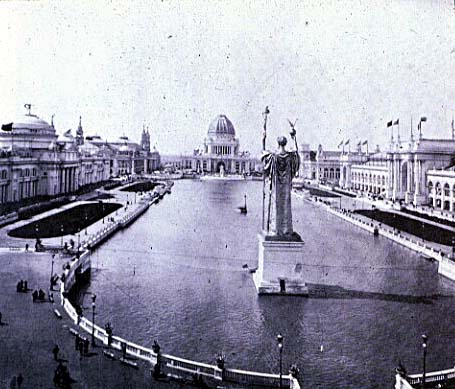
World’s Fairs became grand festivals in America, where imposing and glorified temporary structures would be erected in record time to house the exhibits. The World’s Columbian Exposition in Chicago, 1860 exemplified this practice, with a vast “Court of Honor” featuring architecture designed to look like that of European Royalty. The few permanent buildings boasted record heights, allowing attendees to look out on the whole proceedings. Within this festival, technological advancements were presented as a narrative of progress and efficiency, with American technical achievements attesting to the nation’s wealth and plentitude. Technology glorified the nation, and Western society, while in the layout of the fair a clear line was drawn between the powerful and the primitive. The exhibits featuring non-European nations were gathered in the Midway, along with the bawdy “lower” forms of entertainment. Technology also represented a promise––and this perception has endured through the last century––that industrial and scientific advancement would lead to social progress and better lives for individuals. The “World of Tomorrow” would be clean, safe, and prosperous. For the underprivileged urban working class, this was a captivating dream.
In “A Century of Progress”, the Chicago World’s Fair of 1933, the focus of technology had shifted somewhat. No longer was the preeminent concern with what technology could do to fulfill humanities needs and desires, but rather merely what technology could do. The exhibits demonstrated that technology could bring the distant near, making objects geographically mobile. Also mobile was technology itself––many of the marvels at the fair moved, amazing the audience. Perhaps this was technology’s most appealing ability: to wow viewers, to create illusions and entertain. Technology was not the only thing at the fair designed purely to entertain and shock people. The most shocking exhibits were... well, people. 1933 saw the genesis of the Freak Show, showcasing peculiar and disfigured individuals that (subconsciously or otherwise) provided a foil for the idea of the ideal Western person. Among these freak shows was a town inhabited entirely by little people. Once again, viewers were enabled to survey the exhibit from a greater height, and feel comparatively empowered.
The “World of Tomorrow” fair in New York, 1939, saw yet another shift. Now the focus was not what technology could do, but what it might yet do. It showed an ideal future world, with architecture composed of perfect geometric forms, and lifestyles consisting of perfect, easy living, where technology saw to all difficulties and responsibilities. Another ideological shift apparent in this fair was the transition from technology aggrandizing a national identity to promoting corporate identity. Advertising and the consumer market took center stage, with companies showcasing their futuristic cars and appliances. General Motors had its own building, where it displayed cars that were introduced by the ultimate future fantasy: a subservient and intelligent robot.

No comments:
Post a Comment