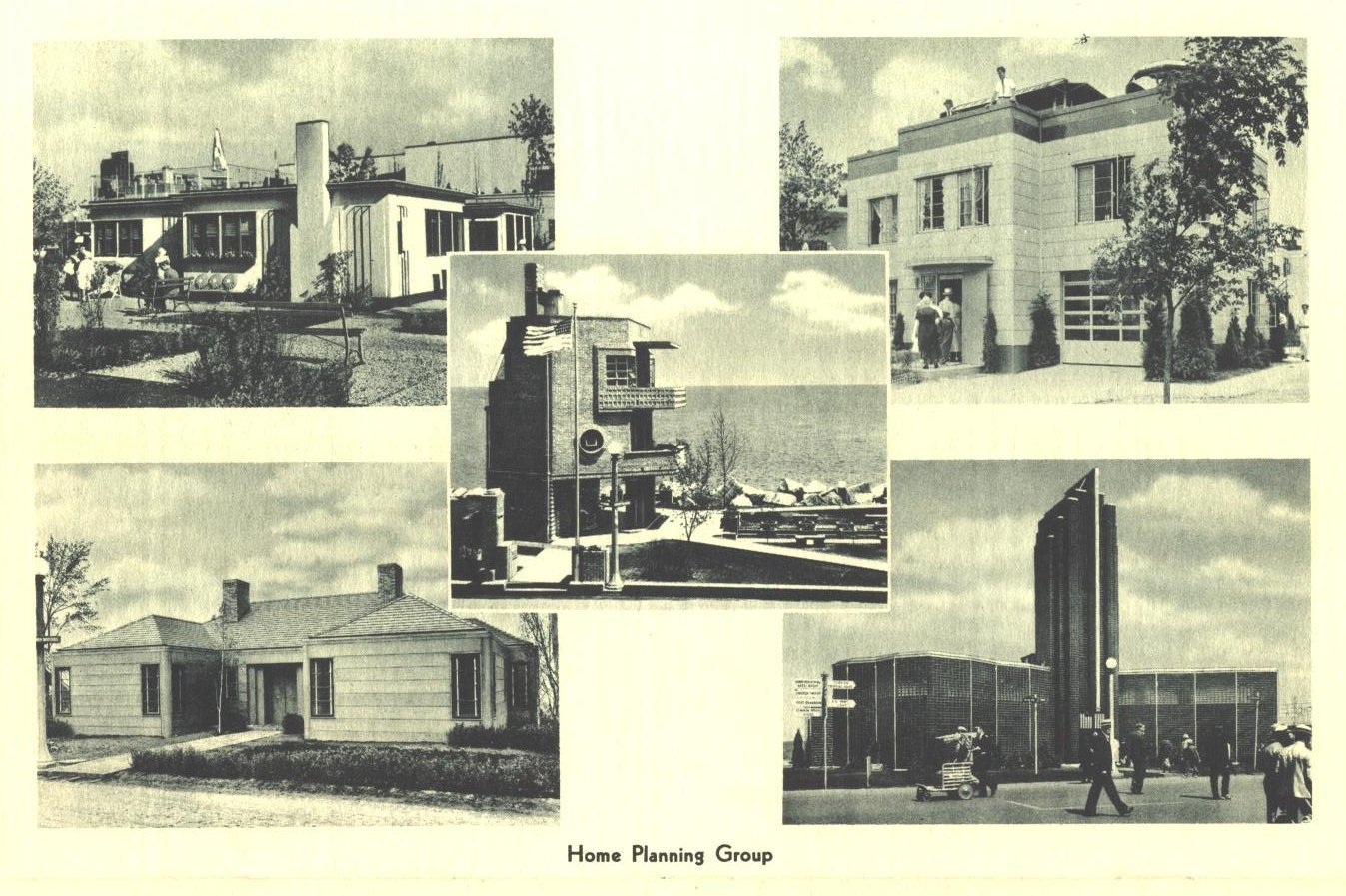
An early version of a prefab home was sent from England in the 1600s, but real prefabrication did not take off until the arrival of "house kits." House kits contained all of the house's parts, so the owners built the homes themselves or hired people to construct them. The Aladdin Company started selling the earliest house kits from its catalog in 1906. One of the best-known early kit-home sellers was Sears, Roebuck and Co., which sold more than 100,000 homes from 1908 to 1940.
Many architects, industrialists, and artist contributed to the prefab movement. Drawing inspiration from the ideas of aesthetic innovation in everyday items that had been cooking in the German Bauhaus, Some American designers believed it was time for a big change in architecture. Prefab houses featured prominently in World's Fairs of the 1930s, touted as the "House of Tomorrow". Buckminster Fuller (who decades later would design the geodesic dome) even proposed an octagonal house with a central elevator, glass walls, and a personal aircraft garage.
Practical factors contributed to the appeal of the kit homes as well. Companies benefited from the automotive, iron, steel and coal industries that were booming. Housing parts, instead of being constructed on site by carpenters, could be mass-produced on conveyor belts and shipped to the site for much lower costs. Plumbing and electrical wiring could also be installed much more cheaply at a factory. Some designers developed a panelized form of house, with different pieces for doors, windows, walls, etc, thus allowing the customer to create a house to their own liking with the basic building blocks.
Lower costs meant more middle-class Americans could build homes. For less than $2,500, the home buyer received a kit containing about 30,000 pieces -- including everything from lumber to nails and hardware to paint and shingles -- plus a book on how to construct the home. But after the stock-market crash of 1929, not nearly as many people had the money for their own homes, and kit-home sales declined.
By the '70s, the government decided to regulate the manufactured homes for safety reasons, and in 1976 the government adopted the U.S. Department of Housing and Urban Development building code. It set standards for heating, plumbing and electrical systems, as well as structural design, construction, fire safety and energy efficiency. After that, manufactured homes became a source for low-cost housing.
However, in the past few decades innovations have allowed manufactured homes to cater to a more upscale market and to those looking to go "green." And people in more crowded countries looking to build affordable, durable housing have also turned to prefab. Just look at what the future may hold: http://www.zerohouse.net/

No comments:
Post a Comment